Show Mobile Navigation
Powered by Blogger.

Friday, October 24, 2014

Clouds That Look Like Things

XPlanet - 10/24/2014 08:44:00 PM
Spotting shapes in clouds is a delightful way to pass a lazy afternoon. There's even a society dedicated to cloud spotting. It’s called the Cloud Appreciation Society, founded by Gavin Pretor-Pinney to foster understanding and appreciation of clouds, and to fight “blue sky thinking”.

A clear blue sky has always been associated with good, happy weather – a perfect summer’s day, while cloudy skies are regarded as a metaphor for doom. Nothing could be more depressing, it seems, than to have ‘a cloud on the horizon’. Gavin Pretor-Pinney decided that this has to stop. “Someone needs to stand up for the clouds”, he says. So in 2004, he started the Cloud Appreciation Society and few months later launched a website. People sent in their cloud photograph, which he put up on the gallery pages for others to look at. The early trickle of submission soon swelled to a torrent. Today, it has over 29,000 members worldwide from 83+ different countries, and many thousands of amazing images.

Below is a collection of some of the most peculiar cloud formations.

clouds-that-look-like-things
alexmonkey
A cloud monkeying around over Bangkok. Photo by Alex Cliff
alien
Cloud Alien ahead.....Eagle River Valley, Colorado. U.S. Photo by Terry Robinson.
Aladdin's lamp, spotted over The Torres del Paine National Park, Chile. Photo by Andrea Andreoli.
baby
A baby floats over Zurich, Switzerland. Photo by Danièle Siebenhaar.
chicken
The big chicken on the roof of Manor Market in Bishop California, is being mirrored in the clouds. Photo by Andrew Kirk.
dog
dolphin cloud hastings sussex
A dolphin leaping from an inky black sea over Sussex, UK. Photo by Beryl Pratt.
dolphin
Dolphins at play, Sausalito, California. U.S. Photo by David Holbrooke.
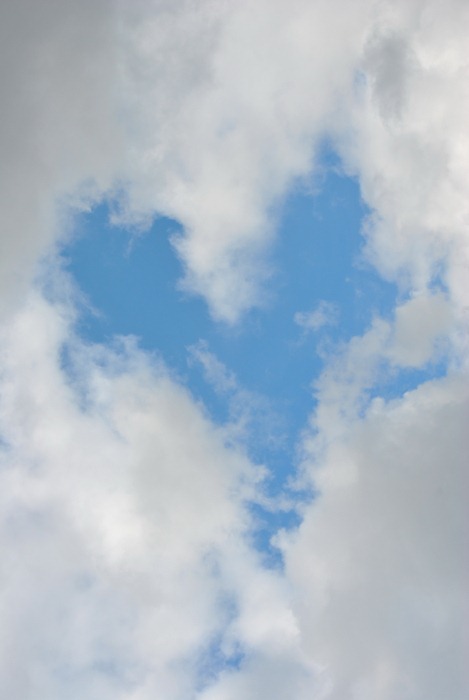
Dougheart
A heart in the clouds over Norwich, UK. Photo by Doug Taylor
DOVEPAULES
A Dove over Kent, UK. Photo by Pauline Reay-Earnshaw
eagle cloud
Eagle soars over Cambridge. U.K. Photo by Christie Nel.
elephant
Elephant in a storm cloud, taken on holiday at Patong Beach, Phuket, Thailand. Photo by Graham Blackett.
feather
A feather over Brockenhurst in the New Forest, Hants., UK. Photo by Chris Gleed-Owen
heart
A heart over SuperDevoluy, Saint Etienne en Devoluy, France. Photo by Emily Morus-Jones
hummingbird
A hummingbird over Berryton, Kansas, US. Photo by Shannon Franks
JackPalanceCloseUp
Jack Palance, spotted over Loudonville, Ohio, US. Photo by Catherine Wilson
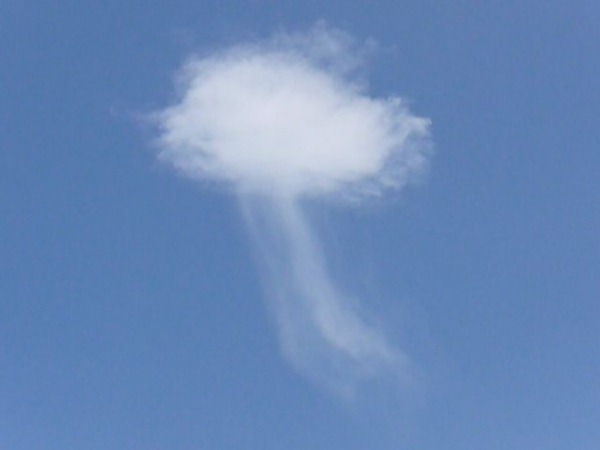
jellyfish
A jellyfish over Berry, New South Wales, Australia. Photo by Mark Muirhead.
kitty
A cumulus called Kitty, Western New York. U.S. Photo by Diane Mariotti.
man with flowers
A man running with a bouquet of flowers. Spotted over France. Photo by Rudolf Wehrung.
mushroom
A giant Mushroom over North Jutland, Denmark. Photo by Jan Hertoghs
poodle cloud 1
Poodle spotted over Sanderstead, Surrey. U.K. Photo by Alex Brooker.
poodle
A poodle with shades enjoys a day by the sea over Blackpool, Lancashire, UK. Photo by Bill Williamson.
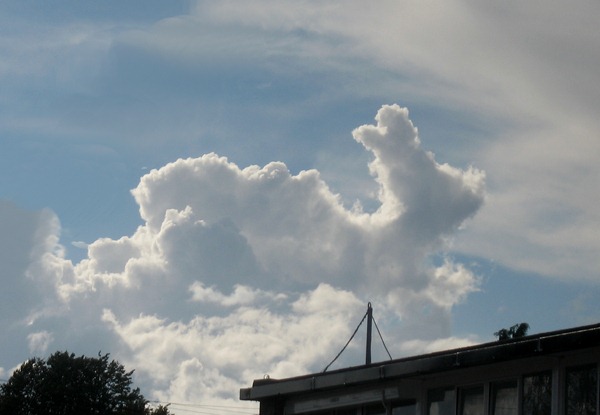
rabbit chilwell
A rabbit hopping over Nottinghamshire, UK. Photo by Andy Jamieson.
rat
Shhhhhh dont tell anyone. There's a monster rat over Tortona, Alessandria, Italy. Photo by Pietro Cordelli.
smiley
A sunset smile over West Hollywood, California, US. Photo by Christine Murphy.
smoking
Little Cumulus cloud from East Texas, US, smoking. Photo by Jan Morris Marek.
snail
A snail, spotted just before sunrise over Anglesey, UK. Photo by John Rowlands
Turtlecrocodile
A turtle travelling on the back of a crocodile over the border between France and Spain. Photo by Jean-Francois Guillot
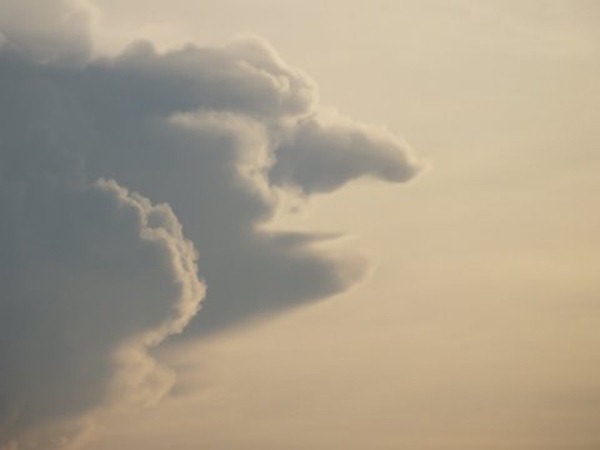
witch
A witch or the grumpy old man in the muppets over Bangkok. Photo by Alex Cliff.
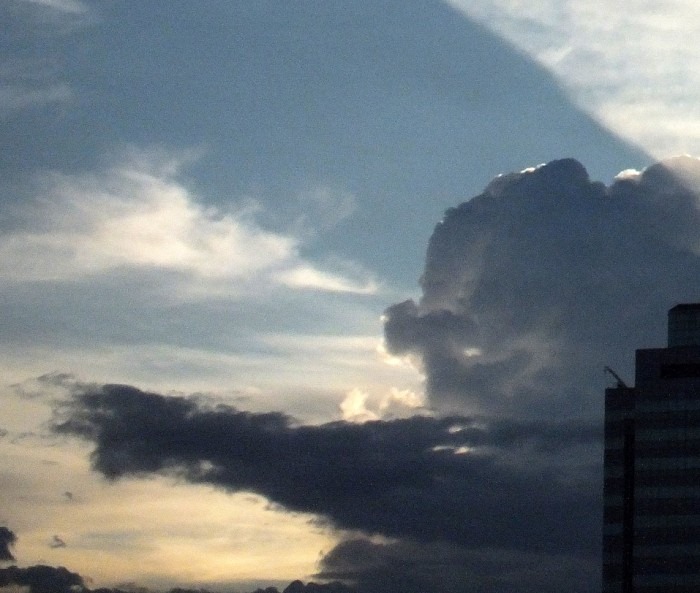
yourefired

The iconic scene from TV programme The Apprentice, when Lord Sugar says "you're fired", acted out over Bangkok. Photo by Alex Cliff

Punch Hole Clouds

XPlanet - 10/24/2014 08:43:00 PM
Punch hole clouds, also known as fallstreak hole are large circular clearings that can appear in cirrocumulus or altocumulus clouds. Such holes are formed when the water temperature in the clouds is below freezing but the water has not frozen yet due to the lack of ice nucleation particles. When a portion of the water does start to freeze it will set off a domino effect causing the water vapor around it to freeze and fall to the earth as well. This leaves a large, often circular, hole in the cloud.

Punch hole clouds have been puzzling sky gazers and scientists alike since the 1940s. A 1968 article in the magazine Weatherwise called them “A Meteorological Whodunit?”.

Because of their rarity and unusual appearance, fallstreak holes are often mistaken for or attributed to UFOs. It is only during the last decade the cause of formation of these clouds has been somewhat understood.

It is believed that a disruption in the stability of the cloud layer, such as that caused by a passing jet, may induce the domino process of evaporation which creates the hole. Such clouds are not unique to any one geographic area and have been photographed from the United States to Russia

punch-hole-clouds-1

punch-hole-clouds-2
punch-hole-clouds-6
punch-hole-clouds-8
punch-hole-clouds-9
See more pictures of Punch Hole Clouds at WeatherVortex

Curious Rock Formation of Giant's Causeway in Ireland

XPlanet - 10/24/2014 08:42:00 PM
The Giant's Causeway in northeast coast of Northern Ireland, is an area of about 40,000 interlocking basalt columns, the result of an ancient volcanic eruption. The tops of the columns form stepping stones that lead from the cliff foot and disappear under the sea. Most of the columns are hexagonal, although there are also some with four, five, seven and eight sides.

giants-causeway (2)

The remarkable geological features of the region have earned it the title of the Eight Wonder of the World and established it as a major part of Ireland's heritage. For 300 years the Causeway and the cliffs of the Causeway Coast have attracted thousands of visitors from around the world. Travellers have marveled at the beauty of the formations while scientists have sought to describe and explain them.

The causeway was formed during the early Paleogene period some 50 to 60 million years ago over a long period of intense volcanic activity. Highly fluid molten basalt intruded through chalk beds to form an extensive lava plateau. As the lava cooled rapidly, contraction occurred. While contraction in the vertical direction reduced the flow thickness (without fracturing), horizontal contraction could only be accommodated by cracking throughout the flow. The extensive fracture network produced the distinctive columns seen today. The basalts were originally part of a great volcanic plateau called the Thulean Plateau which formed during the Paleogene period.

Giant's Causeway was declared a World Heritage Site by UNESCO in 1986, and a National Nature Reserve in 1987 by the Department of the Environment for Northern Ireland.

giants-causeway (1)
giants-causeway (4)
giants-causeway (5)
giants-causeway (6)
giants-causeway (8)
giants-causeway (9)
giants-causeway (10)
giants-causeway (13)
giants-causeway (17)
giants-causeway (18)
giants-causeway (3)
giants-causeway (15)

Richat Structure: Eye Of The Sahara

XPlanet - 10/24/2014 08:40:00 PM
The Richat Structure, also known as the Eye of the Sahara, is a prominent circular feature in the Sahara desert of west–central Mauritania near Ouadane. Surrounded by thousands of square miles of nearly featureless desert, this 40-50 km in diameter series of concentric circles is readily visible from space. This prominent circular feature in the Sahara desert has attracted attention since the earliest space missions because it looks like a gigantic bull’s-eye.

Richat Structure is not the site of an ancient meteor crater, as many people originally postulated. These concentric circles are actually alternating layers of sedimentary, metamorphic, and igneous rocks that were pushed upward in a symmetrical anticline, geologic dome, from below due to a small incursion of magma. The structure is a deeply eroded. The sedimentary rock exposed in this dome range in age from Late Proterozoic (2.5 billion years) within the center of the dome to Ordovician (480 million years) sandstone around its edges.

Initially interpreted as an asteroid impact structure because of its high degree of circularity, it is now argued to be a highly symmetrical and deeply eroded geologic dome. Despite extensive field and laboratory studies, geologists have found a lack of any credible evidence for shock metamorphism or any type of deformation indicative of an extraterrestrial impact.

richat-structure-6

In addition, the Richat structure lacks the annular depression that characterize large extraterrestrial impact structures of this size. Also, it is quite different from large extraterrestrial impact structures in that the sedimentary strata comprising this structure is remarkably intact and "orderly" and lacking in overturned, steeply dipping strata or disoriented blocks. A more recent multianalytical study on the Richat megabreccias concluded that carbonates within the silica-rich megabreccias were created by low-temperature hydrothermal waters, and that the structure requires special protection and further investigation of its origin.

richat-structure-3
richat-structure-2
richat-structure-4
richat-structure-5
richat-structure-1

Sources: 1, 2
Next Previous
Editor's Choice