Show Mobile Navigation
Powered by Blogger.
Islands
Showing posts with label Islands. Show all posts

Friday, October 24, 2014

The Pseudocraters of Iceland

Unknown - 10/24/2014 06:10:00 PM
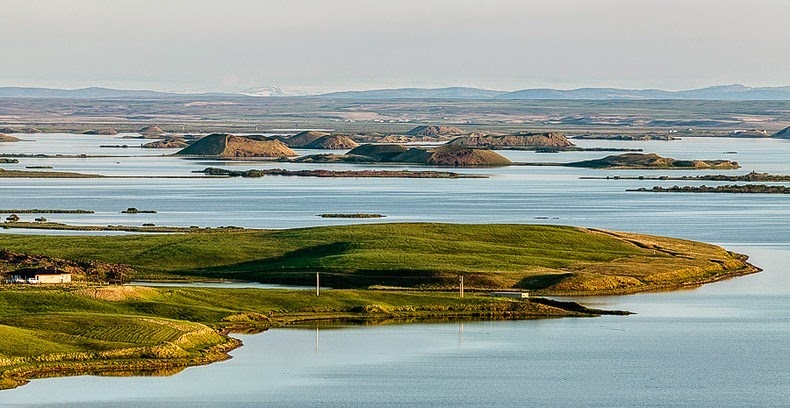
A pseudocrater looks like a true volcanic crater, but is not. These distinctive landforms are created when flowing hot lava crosses over a wet surface, such as a swamp, a lake, or a pond causing an explosion of steam through the lava. The explosive gases break through the lava surface in a manner similar to a phreatic eruption, and flying debris builds up crater-like feature which can appear very similar to real volcanic craters. Pseudocraters are also known as rootless cones, since they are characterized by the absence of any magma conduit which connects below the surface of the earth.

A classic locality for pseudocraters is the Lake Myvatn area of northern Iceland that was formed 2,300 years ago by basaltic lava eruption. The lava flowed down the Laxárdalur Valley to the lowland plain of Aðaldalur where it entered the Arctic Ocean about 50 km away from Mývatn. There was a large lake in the area at the time, a precursor of the present-day Mývatn. When the glowing lava encountered the lake some of the water-logged lake sediment was trapped underneath it. The ensuing steam explosions tore the lava into small pieces which were thrown up into the air, together with some of the lake.

pseudocrater-7
By repeated explosions in a number of locations, groups of craters built up and now dominate the landscape on the shore of Lake Mývatn and also form some of the islands in the lake. The Myvatn pseudocraters occur in several groups around the lake and as islands within the lake. A group of such craters at Skútustaðir on the south shore of the lake is protected as a natural monument and is frequented by tourists. Other pseudocrater groups in this lava field are in the Laxárdalur Valley and Alftaver district. Pseudocraters have also been discovered in the Athabasca Valles region of Mars, where lava flows superheated groundwater in the underlying rocks.

pseudocrater-5
pseudocrater-6
pseudocrater-11
pseudocrater-12
pseudocrater-2
pseudocrater-3
pseudocrater-4
pseudocrater-8
pseudocrater-9
pseudocrater-10

St Michael's Mount of Cornwall

Unknown - 10/24/2014 05:15:00 PM
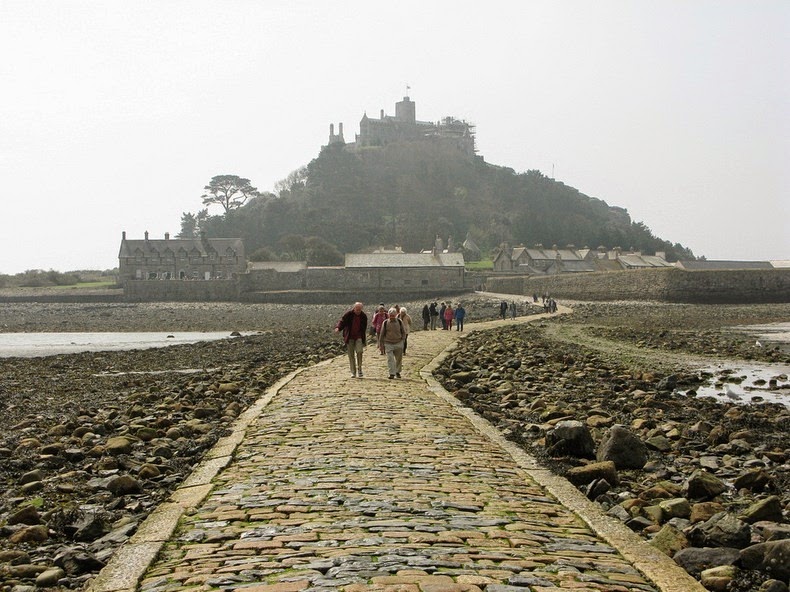
St. Michael's Mount is a tidal island located about 360 meters off the coast of Mount's Bay coast of Cornwall, England. Perched on top of a great granite crag is a castle that was once home to Benedictine monks under Edward the Confessor. Historically, St Michael's Mount was a Cornish counterpart of Mont Saint-Michel in Normandy, France, which shares the same tidal island characteristics and the same conical shape. Just like the French version, a cobbled causeway, that is passable only during low tides, connects the island to the mainland. Otherwise there are small boats that run during high tides.

The chapel was founded by Edward the Confessor in 1044 in a grant to the Benedictine Abbey of Mont Saint Michael in Brittany. Through the Middle Ages, the island was a major destination for pilgrims, and because of its location, it has seen several battles for its ownership. In 1659, St Michael’s Mount was purchased by Colonel John St Aubyn, who had been the last military governor of the island’s garrison, and it became his private home. In 1954, the Mount was gifted to the National Trust.

michael-mount-cornwall-2

Although the St Aubyn family still live there today, visitors are welcomed to take a tour through the fascinating early rooms where many relics, chiefly armour and antique furniture, are preserved. Along with the castle, the Mount is home to some twenty odd residents in a village that has its own church, ancient harbour and beautiful gardens that are full of exotic flora.

One of the most noteworthy points of interest on the island is the island's own underground railway, which is still used to transport goods from the harbour up to the castle. It was built by tin miners around 1900, replacing the pack horses which had previously been used. However, the railway is accessible to tourists.

michael-mount-cornwall-1
michael-mount-cornwall-3
michael-mount-cornwall-4
michael-mount-cornwall-5
michael-mount-cornwall-7
michael-mount-cornwall-6
michael-mount-cornwall-8
michael-mount-cornwall-9
michael-mount-cornwall-10

Sources: Wikipedia / Cornwall Online / BBC

Saint Helena Island: The Place of Napoleon's Imprisonment

Unknown - 10/24/2014 05:12:00 PM
Saint Helena, a British Overseas Territory, is a remote island located in the South Atlantic Ocean about 1,950 km west of the south-western coast of Africa. The nearest land is Ascension Island, the site of a US Air Force auxiliary airfield, which is 1,125 km to the north-west. The most remote inhabited island in the world, Tristan da Cunha, is located 2,100 km to the south. 

Uninhabited when first discovered by the Portuguese in 1502, Saint Helena was garrisoned by the British during the 17th century, and for a long time served as an important stopover for ships sailing to Europe from Asia and South Africa. its importance as a port of call declined after the opening of the Suez Canal in 1869.

Saint Helena's most famous resident was Napoleon Bonaparte, who was exiled there by the British from 1815 until his death in 1821. You can still visit his flower-laden gravesite and residence there. Today, the island is home to some 4,000 residents.

saint-helena-island-1
Jamestown, Saint Helena Island. Jacob’s ladder is visible on the lower part of the image.  Photo credit

Saint Helena is a volcanic island located on the Mid-Atlantic Ridge, composed largely of rugged terrain and perpendicular cliffs rising 500 to 700 meters tall. The only practicable place for ship landings is on the island’s north-western side at James Bay, from which a narrow valley extends 2.4 km inland. In this valley, sandwiched between steep cliffs, is nestled the town, capital and port of Jamestown.

Jamestown is Saint Helena’s most peculiar settlement. The town is rather long, thin and densely populated, with tightly knit, long and winding streets. Shrubs and trees decorate some of the street corners. The surrounding terrain is rough and steep, and rockfalls are an occurrence, sometimes damaging buildings. The town's prominent features is Jacob's Ladder, a staircase of 699 steps, built in 1829 to connect Jamestown to the former fort on Ladder Hill. The ladder is very popular with tourists, is lit at night and a timed run takes place there every year, with people coming from all over the world to take part. Other interesting sites to visit include the Museum of Saint Helena, the impressive High Knoll Fort, and Napoleon's two residence - Longwood House and the Briars, and his tomb.

Longwood House, in the town of the same name, was the home in which Napoleon spent the great majority of his time on Saint Helena and also where he died. It has several wings and contains the type of furniture it would have when he lived there, though most of the originals have been carried off elsewhere. The house is now run as a museum and maintained by the French government.

saint-helena-island-2
Being one of the most remote islands in the world and with no commercial airports, travel to the island is by ship only. RMS Saint Helena, the island’s only lifeline, runs between St Helena and Cape Town, also visiting Ascension Island and Walvis Bay, and occasionally voyaging north to Tenerife and Portland, UK.

Life is slow and hard in Saint Helena. There are no chain stores here and the handful of local shops close for the day at 4pm. Wednesday is a half-day and few businesses open at all at the weekend. Shelves in the supermarket remain empty most of the time, until the ship arrives, and then stocks disappear again. There is no mobile network on the island, and internet connection is irregular and spotty. Economy is weak and is almost entirely sustained by aid from the British government.

Unemployment is a persistent problem, and many residents work abroad. The island’s only attraction is its remoteness, but few tourists are willing to spend six days in a ship to reach it. Last year, only 3,200 visitors arrived on the island.

Saint-Helena-Island-3
Saint-Helena-Island-5
Jacob’s ladder. Photo credit
Saint-Helena-Island-6
Saint-Helena-Island-8
Saint-Helena-Island-10
RMS St Helena in port of Jamestown, Saint Helena Island. Photo credit
Saint-Helena-Island-11
Saint-Helena-Island-12
Longwood House, Napoleon's residence on Saint Helena Island. Photo credit
saint-helena-island-4
Longwood House, Napoleon's residence on Saint Helena Island. Photo credit
Saint-Helena-Island-13
Saint-Helena-Island-14

Sources: Wikipedia / Wikitravel / BBC
Previous
Editor's Choice