Show Mobile Navigation
Powered by Blogger.
Asia
Showing posts with label Asia. Show all posts

Friday, October 24, 2014

Buffalo Bodypainting Competition in China

XPlanet - 10/24/2014 08:37:00 PM
Artists from eight countries gathered in Jiangcheng county in China on May 18 to take part in an international buffalo bodypainting competition. The city of Pu’er has held cattle bodypainting competition for the last three years, and this year’s competition coincides with the 60th anniversary of the founding of Jiangcheng County.

A total of 48 water buffalos were covered in brightly colored body paint. Every cow was painted by a group consisting of 3 to 7 artists from United Kingdom, Italy, Germany, Finland, New Zealand, Vietnam, Laos and China. A prize money of 100,000 yuan ($16,042) was on offer for the most beautifully decorated bovine. This year, the first pace was won by a team of local schoolchildren.

buffalo-bodypainting-1

Painting on the buffalos is an ancient custom in Jiancheng derived from a legend, according to which a group of water buffaloes were once attacked by a large tiger when they were taken to the fields to graze. The tiger caught one unfortunate buffalo and as the two creatures struggled around on the field, mud and blood covered the buffalo's body. The bull looked so terrifying that the tiger got scared and ran away. After that locals started painting on their cattle to keep the predators away. The tradition later developed into a popular festival held each year to celebrate harvest and honor the cattle.

buffalo-bodypainting-4
buffalo-bodypainting-5
buffalo-bodypainting-7
buffalo-bodypainting-8
buffalo-bodypainting-9
buffalo-bodypainting-2
buffalo-bodypainting-3
buffalo-bodypainting-6

Sources: GBTimes / ChinaDaily / Time

Krubera Cave – The World’s Deepest Cave

Unknown - 10/24/2014 06:37:00 PM
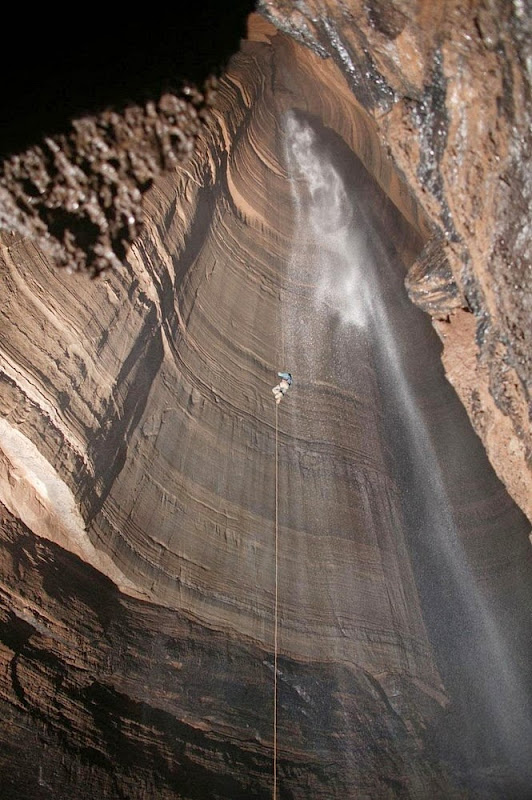
Krubera Cave, also known as Voronya Cave (Russian for “Crow’s Cave”) is the deepest known cave on Earth. It is located in the Arabika Massif, one of the largest high-mountain limestone karst massifs in the Western Caucasus region of Georgia. This mountain block contains several hundred caves that started to develop when the mountains started to rise more than 5 million years ago. Five of these caves are deeper than 1,000 meters; Krubera is 2197 meters deep and is the only known cave on Earth deeper than 2,000 meters.

Krubera Cave is a 16,058 meters long cave system which for most part consists of deep, vertical wells which are interconnected with passages. The cave starts high in the mountains, at an altitude of 2,256 meters, with a narrow entrance. Krubera Cave often is very narrow and had to be carved at many places to allow safe passage. At other places, the passageway is as large as subway tunnel.
krubera-cave-3

At the depth of 200 meters, the cave divides into two main branches: Non-Kuybyshevskaya (explored to the depth of 1,293 m in 2008) and Main (2,197 m deep). At the depth of 1,300 meters the cave further divides into numerous branches.

When speleologists started exploring the cave, one of the hardships they faced were flooded tunnels called "sumps." When they encounter a sump, cavers have to put on scuba gear and charge ahead. One of the sumps – the deepest one - has been dived up to 52 m depth.

The cave now is very popular destination for the expeditions coming from many countries.

krubera-cave-2
krubera-cave-4
krubera-cave-5
krubera-cave-6
krubera-cave-7
krubera-cave-8
krubera-cave-9
krubera-cave-10
krubera-cave-11
krubera-cave-12
krubera-cave-13
krubera-cave-1

Source: Wondermodo / Wikipedia. Photo courtesy: Avaxnews

Kawah Ijen, The Volcano That Spews Blue Flames

Unknown - 10/24/2014 06:13:00 PM
Kawah Ijen is one of several volcanoes located within the 20 km wide Ijen Caldera in East Java, Indonesia. The caldera of Kawah Ijen harbors a kilometer-wide, turquoise colored, acidic crater lake that leaks sulphurous gases constantly. At night the hot gases burn to emit an eerie blue glow that is unique to Kawah Ijen. The gases emerge from the cracks in the volcano at high pressure and temperature, up to 600°C, and when they come in contact with the air, they ignite, sending flames up to 16 feet high. Some of the gases condense into liquid sulfur, and continues to burn as it flows down the slopes giving the feeling of blue lava flowing.

kawah-ijen-13

Kawah Ijen’s sulphuric gases are also mined for sulphur. The volcanic gases are trapped by the local miners and channeled through a network of ceramic pipes, resulting in condensation of molten sulfur. The sulfur, which is deep red in color when molten, pours slowly from the ends of these pipes and pools on the ground, turning bright yellow as it cools. The miners break the cooled material into large pieces and carry it away in baskets to a nearby refinery. A worker can earn up to $13 dollars a day in this way.

The workers work in extremely hazardous condition with insufficient protection. Most of them suffers from numerous respiratory problems due to breathing toxic fumes day in and out. At times they work at night under to escape the heat of the sun, and to earn extra income.

These pictures were captured by photographer Olivier Grunewald, who lost two lenses and a camera to sulphuric corrosion while trying to capture the mysterious pictures.

kawah-ijen-6
kawah-ijen-7
kawah-ijen-8
kawah-ijen-9
kawah-ijen-10
kawah-ijen-5
kawah-ijen-11
kawah-ijen-12
kawah-ijen-1
kawah-ijen-3
kawah-ijen-4

The Tri-Colored Crater Lakes of Kelimutu, Indonesia

Unknown - 10/24/2014 05:50:00 PM
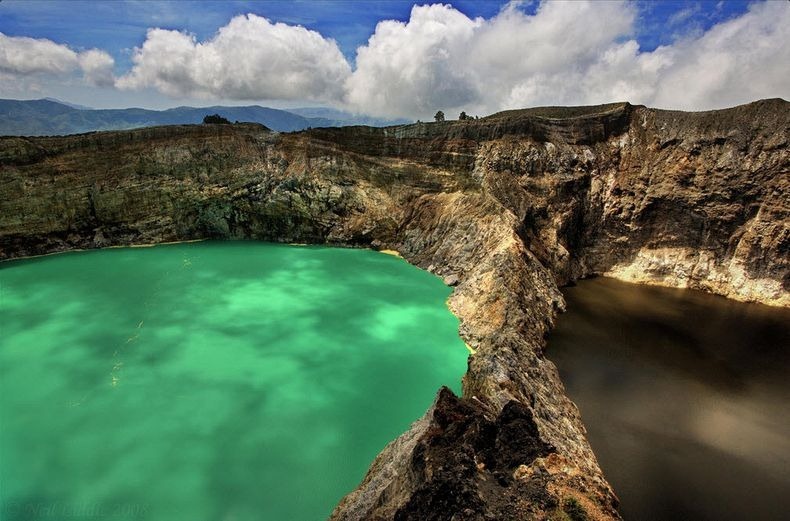
Kelimutu is a small, but well-known volcano in central Flores Island of Indonesia, close to the small town of Moni about 50 km to the east of Ende. At the summit of the volcano there are three crater lakes of varying colors. Although they share the crest of the same volcano and are practically side-by-side, the lakes periodically change colors from red and brown to turquoise and green, independent of each other.

The peculiar colors and thick mist surrounding the volcano have earned Kelimutu a supernatural reputation. Local villages believe that the spirits of the dead go to rest in one of the lakes based upon the deeds performed on Earth. Consequently, the lakes are named Tiwi Ata Mbupu (Lake of Old People), Tiwu Nua Muri Kooh Tai (Lake of Young Men and Maidens) and Tiwu Ata Polo (Lake of Evil Sprits, or Enchanted Lake).

kelimutu-1

It is believed that the lakes change colors as a result of chemical reactions resulting from the minerals contained in the lake perhaps triggered by volcano gas activity.

The scenic lakes are a popular tourist destination and have been the source of minor phreatic eruptions in historical time. They were once featured on the rupiah - the national currency of Indonesia.

kelimutu-0
kelimutu-4
kelimutu-5
kelimutu-2
kelimutu-3

The Bizarre Landscape of YehLiu Geopark

Unknown - 10/24/2014 05:49:00 PM
Yehliu is a cape on the north coast of Taiwan in the town of Wanli, famous for its stunning geological landscape. The unique rocks are concentrated at a region called the Yeliu Geopark - a 1,700 meter-long peninsula jutting out into the ocean and dotted with strange rock formation such as mushroom rocks, honeycomb rocks, ginger rock, pothole erosion and other appropriately named oddities.
A number of rock formations have been given imaginative names based on their shapes. The most well-known is the "The Queen's Head", an iconic image in Taiwan and an unofficial emblem for the town of Wanli. Other formations include "The Fairy Shoe", "The Bee Hive", "The Ginger Rocks" and "The Sea Candles. Many of these rocks contain fossils, which showcase creatures native to Taiwan from a not-so-distant-past.
The area is studded with seawater-eroded holes teeming with sea-life, as well as unusual rock formations, which make the surrounding environment rich in ecological resources. Sun, wind, rain, waves and strong northeastern typhoons all make a major impact on this narrow strip of land.
yehliu-geopark-1
yehliu-geopark-2
Ginger rocks. Photo credit.
yehliu-geopark-15
There are around 180 mushroom rock formations in different stages of erosion. Amongst them, you’ll find Yehliu’s most recognizable landmark, the Queen’s Head Rock. Photo credit.
yehliu-geopark-14
The Fairy Shoe. Photo credit.
yehliu-geopark-5
Candle rocks have a ball-shaped core standing out from the rest of the rock. Photo credit.
yehliu-geopark-6
yehliu-geopark-7
yehliu-geopark-8
Honeycomb rocks are mushroom-shaped, but the surface of these rocks is covered with holes of different shapes and sizes.Photo credit.
yehliu-geopark-9
yehliu-geopark-10
yehliu-geopark-13

Previous
Editor's Choice